Rebuilding a tired tooth.
Handmade porcelain for teeth that are too broken down to build up in the chair, or to fill a gap using the teeth on either side.
What are porcelain crowns and bridges?
A crown is a covering made in a laboratory that fits over your tooth and gives it back its shape, its strength and its looks. A bridge fills a gap by joining a replacement tooth to crowns on the teeth either side. Both are usually made from modern all-ceramic materials that are strong and catch the light much the way real enamel does, so they do not look like dentistry.
Why I have suggested this for you
I suggest a crown when a tooth is too broken down, cracked or heavily filled for a normal filling to hold reliably, or after a root canal on a back tooth where what is left has become brittle. A bridge is one way of filling a gap, and I will only recommend one over an implant where there is a genuine reason, such as the neighbouring teeth already needing crowns anyway, or implants not being possible for you.
What actually happens
At the first appointment I numb the tooth and reshape it to make room for the crown, taking away the weakened parts and any old filling material. Then I take a digital scan and match the shade carefully against your other teeth, usually with you holding a mirror so we agree on it. You go home with a temporary crown while the laboratory makes the real one, which takes two to three weeks.
At the fitting appointment the temporary comes off and I try the crown in, checking the fit, the way it meets the neighbouring teeth, your bite and how it looks. I adjust it until it feels like nothing at all, because a crown you can feel is a crown that is not quite right. For a front tooth I will usually send you to the window to look at it in daylight and tell me honestly what you think before it goes in for good. Please do be particular. It is much easier to change now.
The risks you should know about
Preparing a tooth for a crown cannot be undone; the enamel taken away does not grow back, which is why I only suggest it when a filling genuinely will not do. In a proportion of crowned teeth, especially ones that had deep decay or big old fillings, the nerve becomes irritated and may eventually need root canal treatment. Cold sensitivity in the weeks after preparation is common and normally settles down.
Crowns and bridges can chip, and now and then one comes loose and needs recementing. Decay can start at the edge where the crown meets your tooth, which is why cleaning right at the gum line matters so much. With a bridge, the supporting teeth are carrying extra work for years, and if one of them fails the whole bridge usually has to be replaced.
What you should get out of it
A well-made crown holds a weakened tooth together and stops it splitting, which can add many years to its life, and it looks entirely natural while doing it. Modern all-ceramic materials avoid that grey line at the gum you may remember from older metal-backed crowns. A bridge fills a gap without any surgery at all and is finished in a few weeks instead of months, which suits some people very well.
Looking after it at home
Clean carefully right where the crown meets the gum, because that is where any trouble starts. Brush twice a day and use interdental brushes or floss every day. If you have a bridge, do clean underneath the replacement tooth with superfloss or a water flosser without fail; we will show you exactly how.
Try to avoid biting anything really hard, and please wear your nightguard if you grind, as grinding is the main reason ceramic breaks. Keep up your check-ups so I can examine the edges and take the odd x-ray. And do tell me about any sensitivity, looseness or change in your bite sooner rather than later.
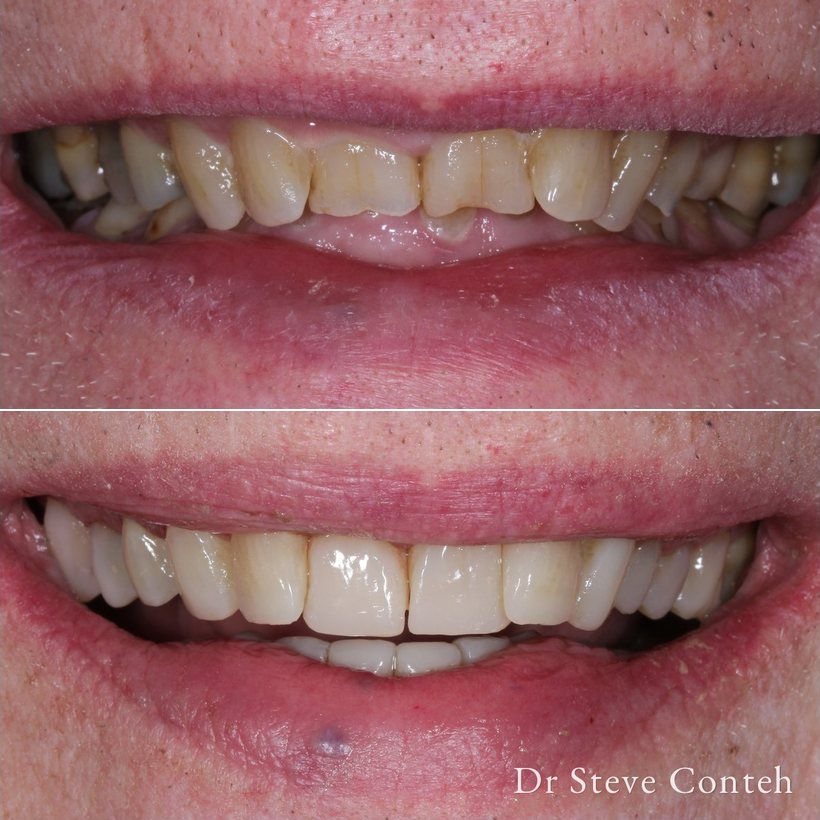
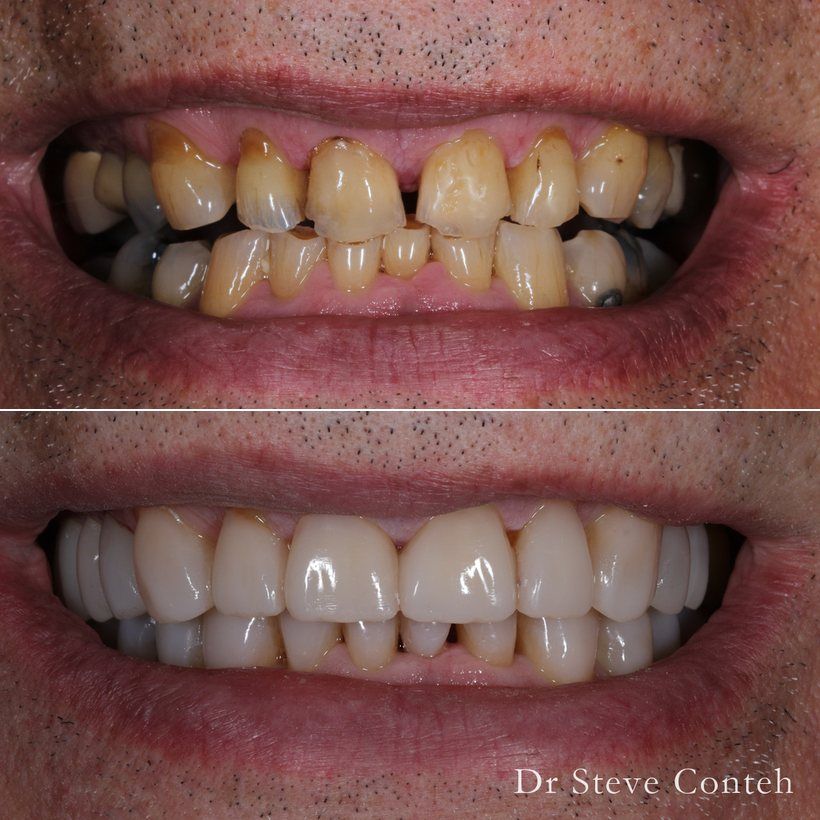
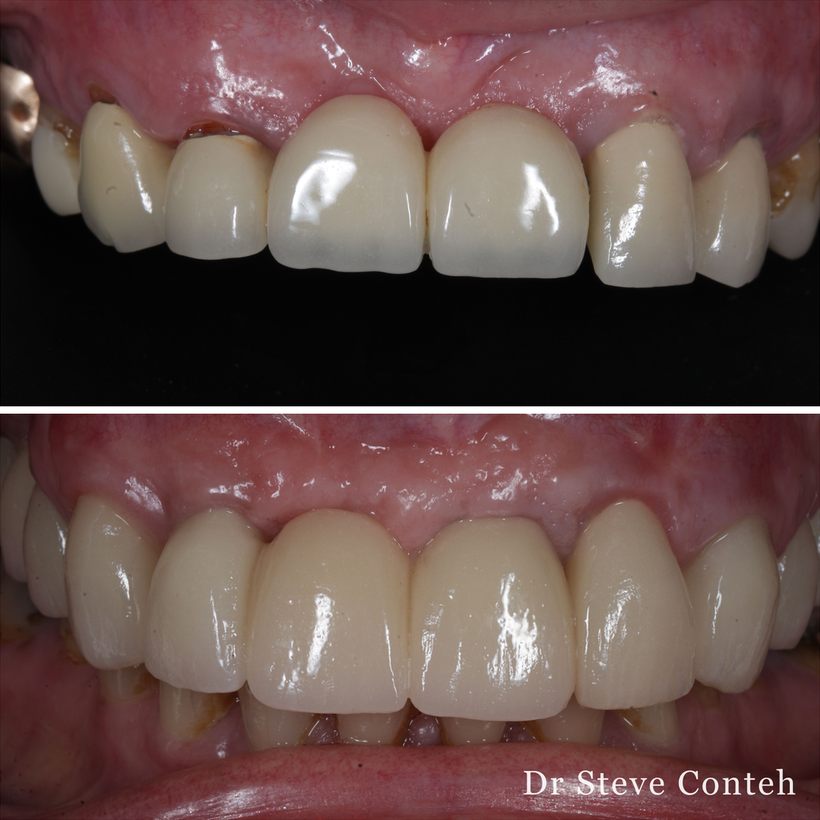
Porcelain Crowns and Bridges: before and after
Questions patients often ask me
How long do crowns last?
Bridge or implant?
Written by me, Dr Steve Conteh, BDS (Hons) MSc, GDC 251055. It explains the treatment in general terms so you can understand it. Your personal plan, with your costs and your risks, always comes to you in writing before anything begins. Please do bring your questions to your appointment. Last reviewed August 2026.
Tell me what is worrying you
The first appointment is a conversation more than anything else. I will listen properly, have a careful look, and then write everything down for you to take home. You can think about it for as long as you need. Nobody here will chase you.