A full set of fixed teeth.
A whole jaw of teeth held firmly on implants, so nothing lifts, nothing rubs and nothing has to come out at night.
What is full-arch implant rehabilitation?
This treatment replaces all the teeth in one jaw with a single fixed bridge, held up by a small number of implants, usually four to six. You may have heard it called All-on-4 or teeth in a day. The important difference from a denture is that you do not take it out. It stays in your mouth and you clean around it, so there is no lifting it out over the sink each night.
Why I have suggested this for you
I have suggested this either because the teeth in that jaw cannot reliably be saved any longer, or because you are wearing a denture that moves, rubs or stops you eating what you would like. When teeth are failing one after another from gum disease, decay or old work breaking down, mending them one at a time starts to feel like a losing battle, and I suspect it already does. This deals with the whole jaw properly, once, in a planned way, so you can stop worrying about which tooth goes next.
What actually happens
This is the biggest treatment I do, so I plan every part of it before we start. I take photographs, a 3D scan, digital scans of your mouth and records of how your teeth meet. From all of that I work out on screen exactly where each implant needs to go, and usually have a small guide printed so that on the day everything goes precisely where it was planned.
On the day, any remaining teeth in that jaw come out, the implants go in, and in most cases a fixed temporary bridge is fitted there and then. You go home with teeth. That temporary is not meant to be the finished article. It is a working version that lets us find out how it looks, how you bite, how you sound and how easy it is to keep clean, all while the implants are healing underneath.
Healing takes about three to six months. We see you regularly through that time, and anything you would like changed about the shape, length or colour gets changed now, while it is easy. Once the implants have taken properly, I take the final scans and your definitive bridge is made in a strong, hard-wearing material. It is fitted, checked over carefully, and then we settle into a routine of looking after it together.
The risks you should know about
This is major treatment, and you deserve to hear the risks plainly and not glossed over. An implant can occasionally fail to take. Because four to six of them are holding your bridge, losing one may or may not matter, depending on where it sits. Some swelling and bruising is completely normal, and occasionally there is more of it than we would like.
Your speech will very likely feel odd for the first few weeks while your tongue gets used to the new shape, and honestly a lot of people find that more unsettling than the surgery itself. It does settle. The temporary bridge can chip or break, which is part of why we have it. There is also a risk of altered feeling in the lower jaw where implants sit near the nerve, and of the sinus being involved in the upper jaw.
Further down the line, the main threat is peri-implantitis, which is inflammation of the gum and bone around the implants. It is closely linked to smoking and to cleaning that has slipped. Your bridge will need servicing over the years and some parts will eventually need replacing. I think of this as a long relationship and not a one-off procedure, and I will be here for it.
What you should get out of it
For the right person the difference is enormous. You get back something close to natural chewing power, well beyond anything a denture can manage. Nothing shifts when you eat or talk. In the upper jaw the roof of your mouth is left uncovered, so food tastes and feels like food again, which patients tell me they had almost forgotten. And the bone that would keep shrinking under a denture is kept busy around the implants instead.
What my patients actually talk about afterwards is rarely chewing. It is going out for a meal without planning it first, and laughing in a photograph without checking it afterwards.
Looking after it at home
Cleaning really is the thing that decides how long this lasts. We will show you how to get underneath and around the bridge with superfloss, interdental brushes and a water flosser, and you will get plenty of practice with us before you are managing on your own. It does need doing every day. Hygiene appointments are usually every three to four months, and now and then I will unscrew the bridge and clean it properly.
I often suggest a nightguard, especially if you grind. Smoking does raise the risk of losing implants, and I will be honest with you about that and help if you want to stop. Above all, please come to every review, even when everything feels fine. Problems spotted early around implants are usually easy to sort out. Problems spotted late often are not, and I would hate that for you.
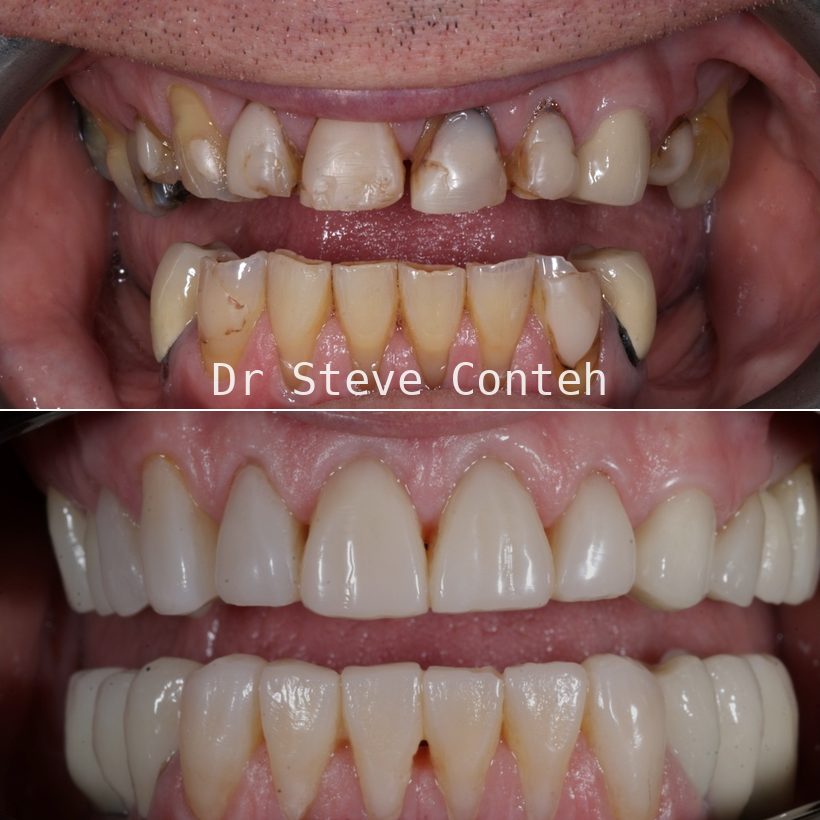
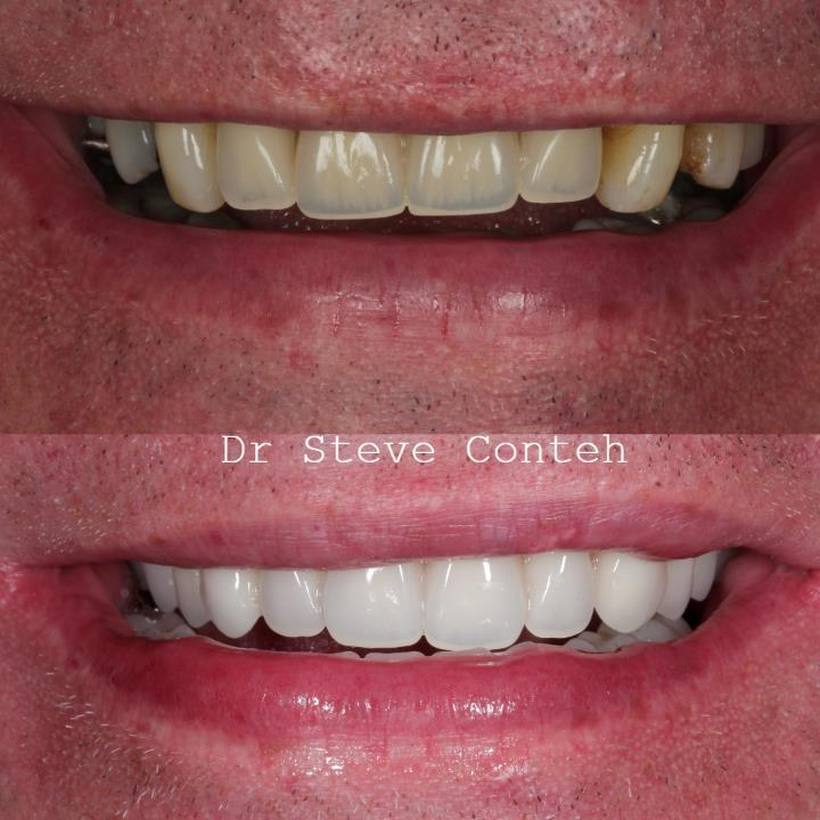
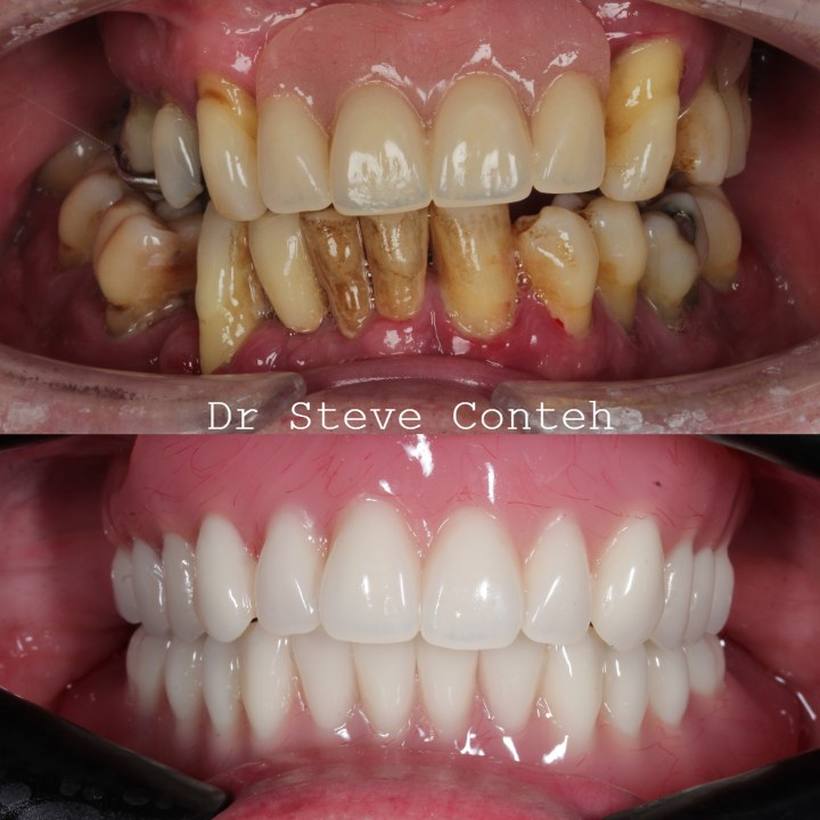
Full-Arch Implant Rehabilitation: before and after
Questions patients often ask me
Is All-on-4 the same as full-arch rehabilitation?
Will I leave with teeth on the day?
Is it better than a denture?
How long does full-arch treatment take?
Written by me, Dr Steve Conteh, BDS (Hons) MSc, GDC 251055. It explains the treatment in general terms so you can understand it. Your personal plan, with your costs and your risks, always comes to you in writing before anything begins. Please do bring your questions to your appointment. Last reviewed August 2026.
Tell me what is worrying you
The first appointment is a conversation more than anything else. I will listen properly, have a careful look, and then write everything down for you to take home. You can think about it for as long as you need. Nobody here will chase you.